The long awaited second episode of the Cartoon Reactions podcast! This episode we are talking about the 1962 John & Faith Hubley classic “The Hole” a fascinating cold war short on the cheery subject of nuclear war. We also chit chat about our favourite animated tv series of all time and our opinions about the DC Animated Universe.
Me and my buddy Oliver have recorded the first episode of a new podcast we have been working on called Cartoon Reactions where we talk about cartoons. In particular I will be showing Oliver a cartoon which I think is interesting and getting his raw reaction to it. The first episode is a bit under 30 minutes and the audio quality and editing isn’t the greatest, but this will hopefully improve in future episodes.
The first episode is going to be on the 1936 cartoon “Popeye the Sailor meets Sinbad the Sailor”. It is luckily in the public domain and a good quality version of it is posted above.
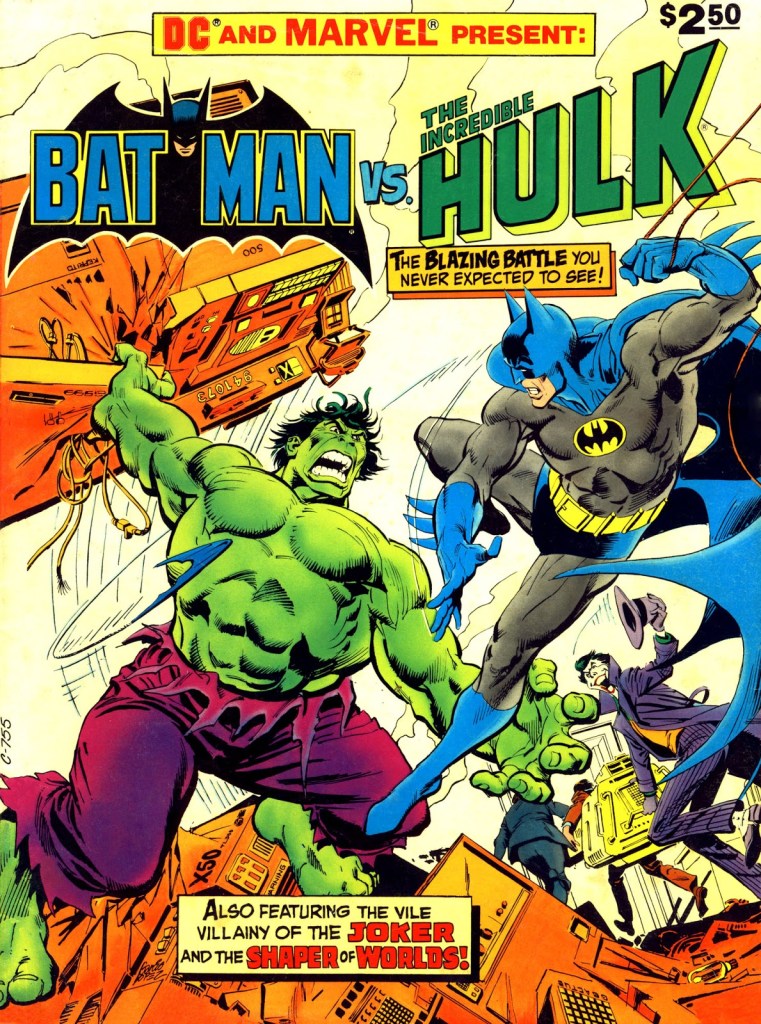
While browsing through a used book store recently I came across a little gem that caught my eye, an old chapbook reprint of the 1981 Batman Vs. The Hulk comic released in collaboration between DC and Marvel. At this point it seems like we have seen every possible Batman story at least several times, so to come across a story which not only has never been done prior, but I am almost certain will never be done again was very intriguing to me. I am glad I did pick up this book as it’s just a lot of fun.
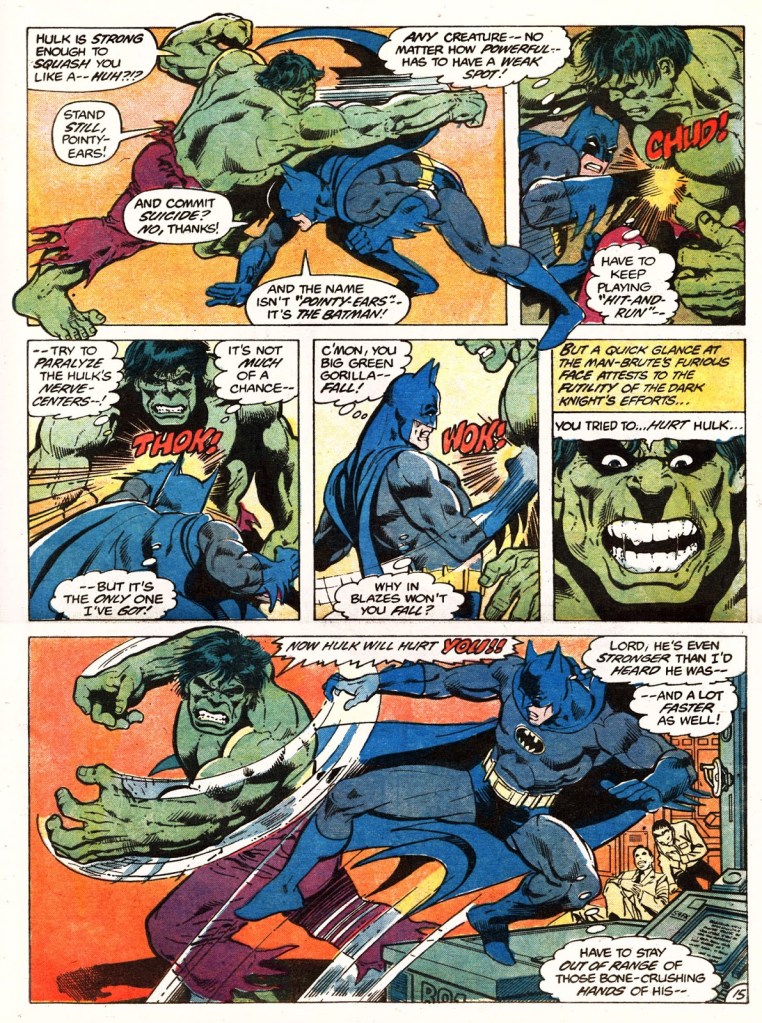
The story was written by Len Wein and drawn by Jose Luis Garcia and is instigated by the sudden appearance of a being known as the Shaper of Worlds into Gotham. The Shaper’s gimmick is that he is a powerful cosmic entity who survives by absorbing the dreams of others, but he has unfortunately recently lost that ability and become fatally ill. He has learned that Wayne industries has in it’s possession a gamma gun which can possibly cure him so he hires the Joker to steal it for him in exchange for making the Joker’s dreams reality. Unfortunately for the Joker, Bruce Banner has taken a job at Wayne Industries working with the Gamma Gun in order to use it to possibly cure him. So when the Clown Prince of Crime riles Banner up a bit during the robbery the scene soon escalates into a three way battle between The Hulk, Joker and Batman.
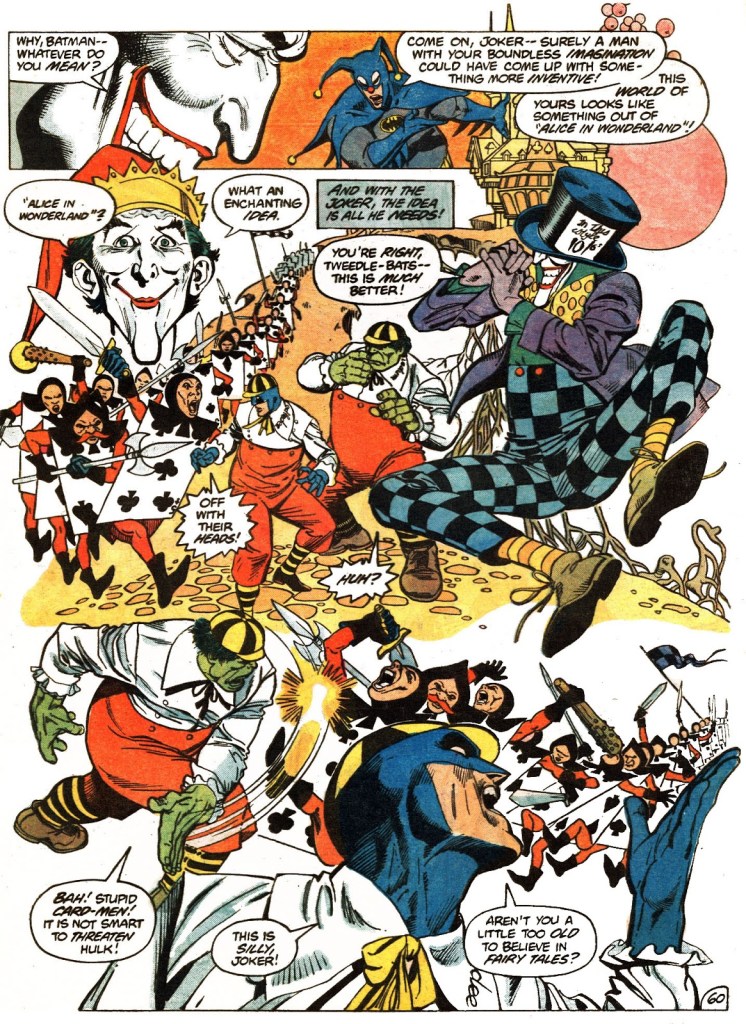
The story continues on from there with Batman first teaming up with Banner to protect the Gamma Gun from Joker and then Batman having to team up with the Joker to trick the Hulk into coming to the Shaper of Worlds so that the residual gamma radiation from the Jolly Green Goliath can cure the Shaper of Worlds and prevent him from destroying all of Gotham. The story reaches it’s climax with the Joker gaining the power from Shaper to make all of his dreams come true leading to a series of spectacular splash pages as Joker shapes reality as he pleases until the strain eventually causes him to collapse. Having saved the day Batman and Banner go their separate ways.
This is hardly one of the best Batman or Hulk stories ever written, but it just a lot of fun. The story flows well and constantly switches up the plot with various twists and turns and the art while not spectacular is very solid. What really makes is special though is that because Wein has experience writing both these characters written both of the characters in the past has a solid grasp of what makes them tick and they both play off well against each other in an entertaining manner. But the most spectacular moments are near the end where Joker becomes all powerful and begins to shape the world at will. I mentioned before that I’m not that big a fan of Garcia’s work, but he can draw a real good Joker and those splash pages near the end are just amazing.
There is just something that feels so old fashioned about a comic like this. It’s a throwback to a period where it was an event when two different super-heroes would show up in the same book, Superman showing up in the Flash was a big deal and presented so many possibilities that your tiny little mind could be barely stand it. Now that there are so many crossovers and the like the team up just seems to have lost a little of it’s magic. What makes these DC/Marvel crossovers so special is that they are still events which only ever happened so rarely that as a reader you had no guarantee that something like this would ever happen again. This is even more true now, as these cross company events have gone from being very rare in the 70’s and 80’s to being non existent today. So when you read this story, you are reading what will probably be the only Batman/Hulk crossover ever written and there is just something special about that.
For whatever reason, I have been on a bit of a Call of Duty kick recently and decided to play the original PC release again for the first time since I was in high school. Made in 2003 by Infinity Ward an offshoot of Medal of Honor:Allied Assault creators 2015 game, CoD is in many ways a spiritual sequel to MoH:AA made during the same WW2 gaming boom in the early 2000’s.
CoD consists of three main campaigns: playing as an American paratrooper in D-Day and then doing some commando stuff, playing as a British paratrooper in D-Day and then doing some commando stuff (this was made right after Band of Brothers came which I imagine is the reason they focused so much on the paratrooper aspect), or playing as a Soviet conscript mostly in Stalingrad.
To be blunt the game has not aged particularly well. The main issue is that the core gameplay is kind of mediocre and not particularly memorable, the guns aren’t particularly interesting to shoot, the AI is dumb and most of the level design is repetitive and uninspired. The main innovation is that you are usually playing as part of a squad and while you can’t command the squad in any way, it does help immerse you feel that you are part of an army and not some random super soldier (the tag line for the game is literally “In the war that changed the world, no one fought alone”) “
This immersion aspect is what made the game so memorable for me back when it first came out. This was as realistic a depiction of World War 2 that there had ever been in a game and the atmosphere really made the levels feel bigger than just a series of corridors which is what they were. The high point is the first Stalingrad level which has you initially unarmed trying to survive until you can find a rifle and then fight through several floors of ruined apartment buildings until you reach an ideal sniper perch to assist the main body of troops assault an entrenched German position. But most of the missions are nowhere near as good as this one and graphics that were so impressive nearly 20 years ago are now significantly less so. I don’t mind the early 2000’s level graphics because that’s what I was brought up on, but I can imagine someone playing the game who wasn’t around in that period thinking it to be quite ugly. Either way I think CoD mostly relies upon it’s presentation of battlefield chaos to paper over the mediocre gameplay and level design and if the graphics are no longer impressive that is really not going to work.
In summary CoD is not a bad game, but I can’t recommend this game to anyone who doesn’t either have nostalgia for that era of shooters or is interested in where the CoD series started. If you are looking for a great WW2 era FPS, the one I would still recommend is Brothers in Arms which is also from this era but holds up fantastically and has great squad based combat with a tactical element.
I have been a fan of animation as long as I can remember, ever since I watched Saturday morning cartoons on the A-Channel growing up in Canada. I never studied animation in any meaningful sense, but over the years I have picked up a few things about how cartoons are created and how they work. Having more free time due to the current Covid related unpleasantness, I have begun to read more and more books and articles on the history of animation and I have watched more and more of the classic theatrical shorts from the so called “Golden Age of Animation”.
I have also been trying to do some more writing and so I decided to combine my two present interests by writing about animation. When I write I like to have some sort of structure to build around, so I have decided to talk about the winners and nominees of the Academy Awards for best animated short films for each year starting from the beginning very. Examining the Oscar lists year by year, allows you to really see how the field of animation changed and evolved. Moreover since the Academy Awards are supposed to represent the best of what the film industry has to offer we can get a better sense of what contemporary Hollywood figures thought was the best in animation and so can better understand what they thought animation should be and how their ideals changed over time. I should be clear that I am not even remotely an expert on the subject of animation history by even the most generous standards so take that in mind when reading this.
At the Ambassador Hotel in Los Angeles on November 18th, 1932, the Academy of Motion Picture Arts and Sciences handed out the 5th Academy Awards. In addition to the usual awards like best picture (won by “Grand Hotel”), these were the first awards which featured a category for animation under the title of “Short Subjects, Cartoons”, the name which the award would go by until the 1970’s. Three shorts were nominated: the Walt Disney produced “Mickey’s Orphans”, the Leon Schlesinger produced “It’s Got Me Again!” and the eventual winner Disney’s “Flowers and Trees”.
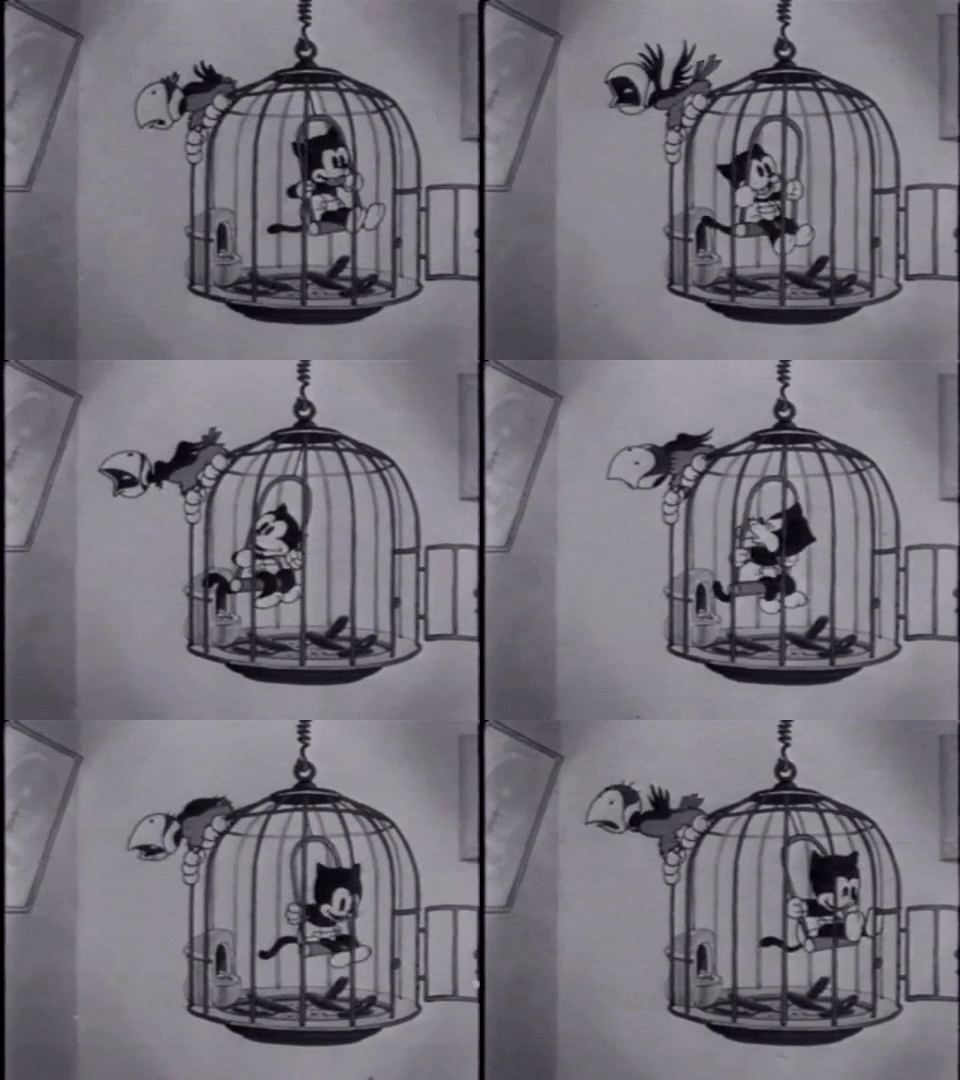
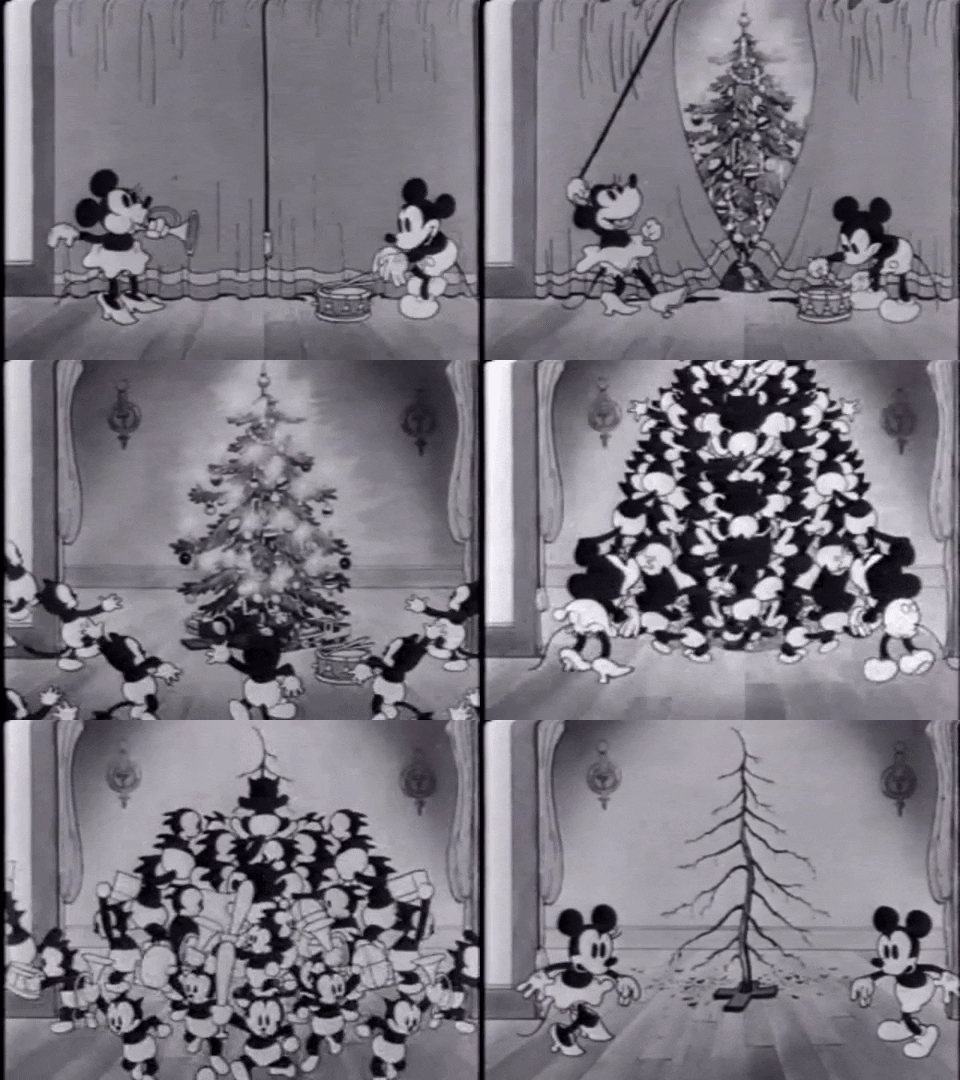
Directed by Burt Gillett, “Mickey’s Orphans” begins in a low key manner at Christmas time. Inside a cozy house during a snow storm everyone is getting ready for the holidays with Mickey decorating the tree, Minnie playing Silent Night on the Organ and Pluto sleeping before the fire. Meanwhile a shawled woman drops off a basket on the door step and when Mickey brings the basket in he finds it contains a bunch of kitten and mischief ensures as the kitties run wild and destroy the house.
This is a cartoon where I think the whole is less than the sum of its parts. There is the initial christmasy set up, but after that the cartoon descends into a series of gags, a kitten kicks out their pet parrot from its cage and its swing and one group grabs Pluto by his ears while a second group grabs him by his tail and they use the dog as a rope to play tug of war.
See, this is a gag! Cute, funny and original, so why don’t I like it.
The individual gags are well animated and fun enough, but they don’t really go anywhere. There is real arch to the story, no development, the cats misbehave and Mickey just stands there smiling like a doofus. The only real advancement of the plot is when Mickey comes in dressed as Santa Clause and gives the kittens toys. But that only leads to further escalation, they destroy furniture with saws and hammers, shoot out windows and break china with pop guns and pour hot coals down Mickey’s pants. Finally culminating when Mickey unveils the Christmas tree and the kittens swarm it like a hoard of locusts stripping it bare.
I am having problems figuring out my feelings about this cartoon, I think it’s fine, but it just feels underwhelming for some reason. I gave a bunch of reasons why that may be so, but I don’t really believe them myself as I like plenty of cartoons which are just an escalating series of gags leading to violence. Especially because the gags are fairly memorable, in part because of how uncharacteristically destructive they are for a Disney cartoon.
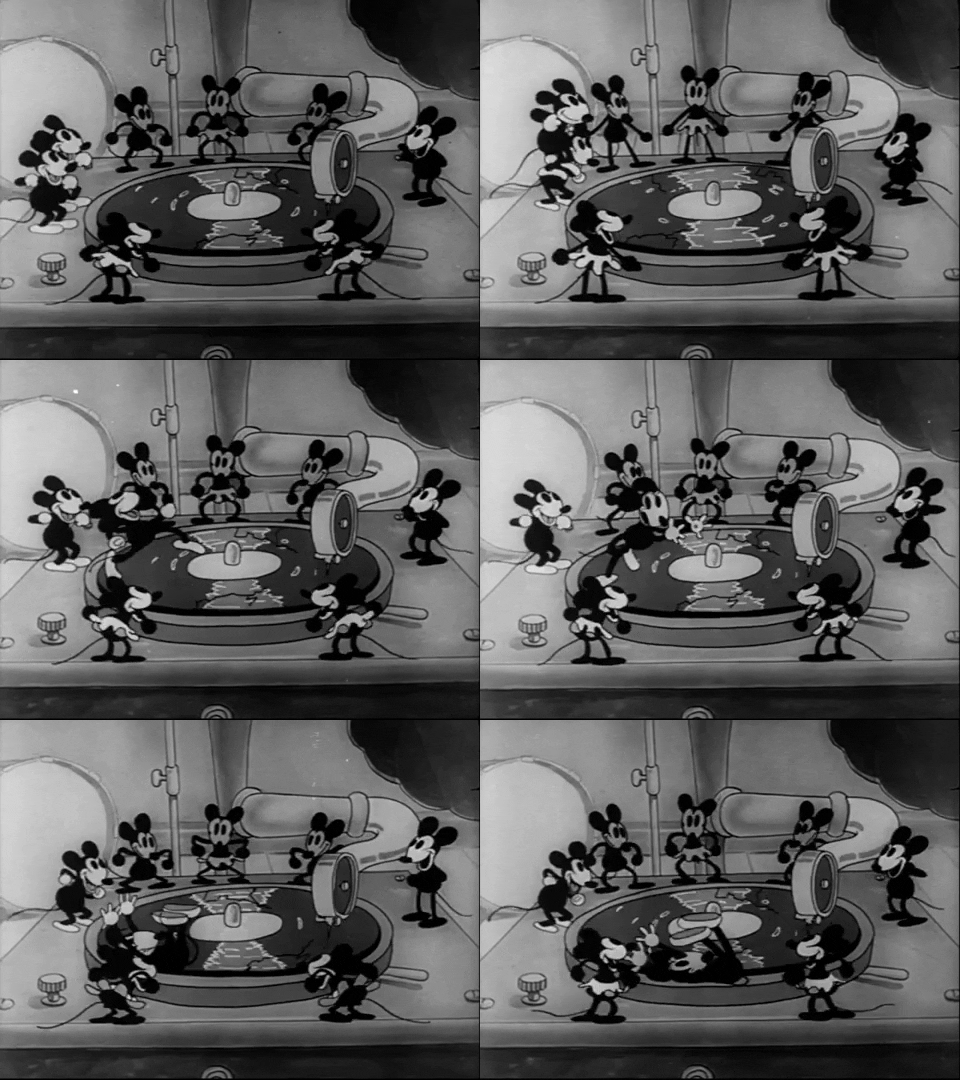
“Its got me again” is a very early Merrie Melodies cartoon by the Harman and Ising team which does a lot of the same things that the Mickey Mouse cartoon does, but nowhere near as well. The animation is stiff and while there are a few good set pieces, it ends up being pretty mediocre. The story is that a bunch of very Mickey Mouse looking mice in a musical instrument store come out after dark and have themselves a party. A cat comes along and spoils their fun, until the mice team up and chase the cat out.
Like the Mickey Mouse cartoon this is mostly just a series of gags of the mice either having fun or fighting back at the cat. There are some good bits like the mice dancing on a running turntable, but most of them fall flat. The animation is a bit stiff and every joke feels like it lasts about a second or two too long. I really don’t have that much too say about it. Its not good and it isn’t bad in any interesting way, just kind of mediocre and forgettable. Really surprised that this got nominated.
This is funny though.
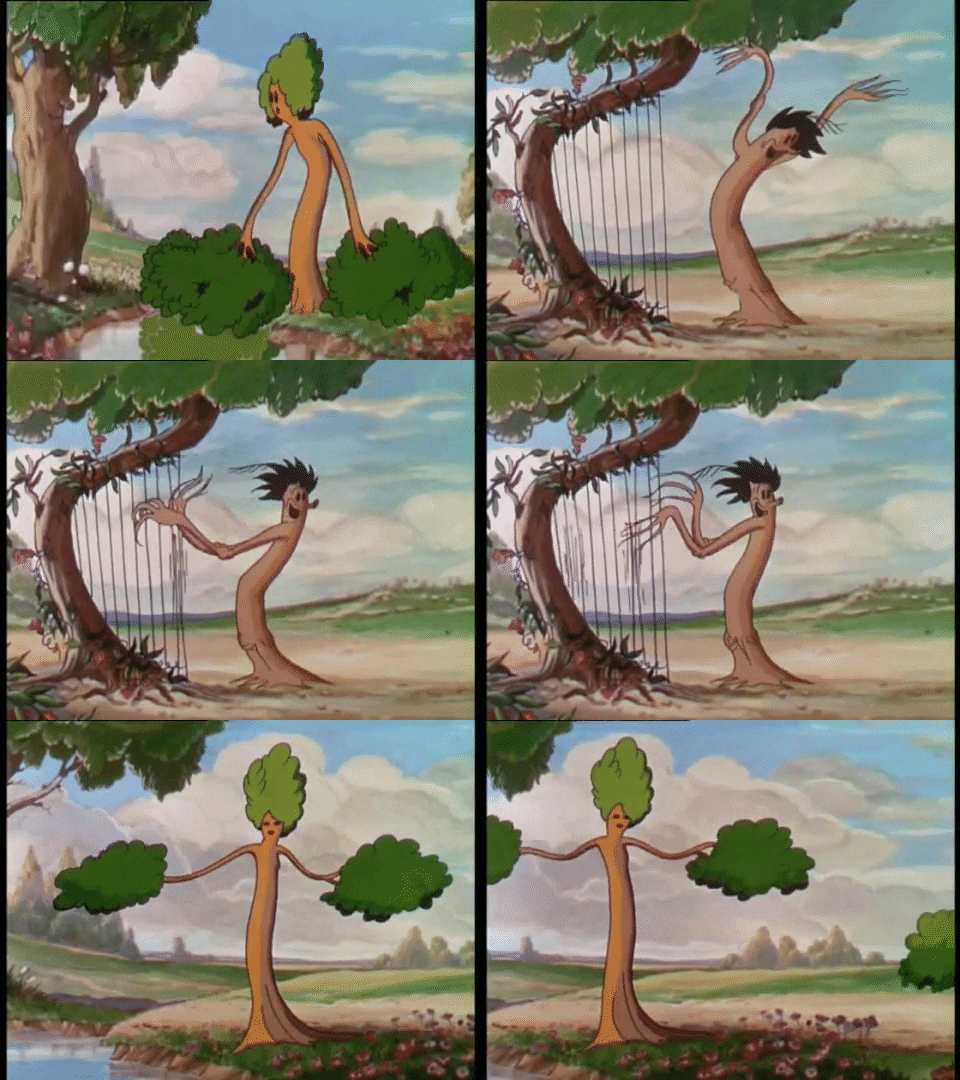
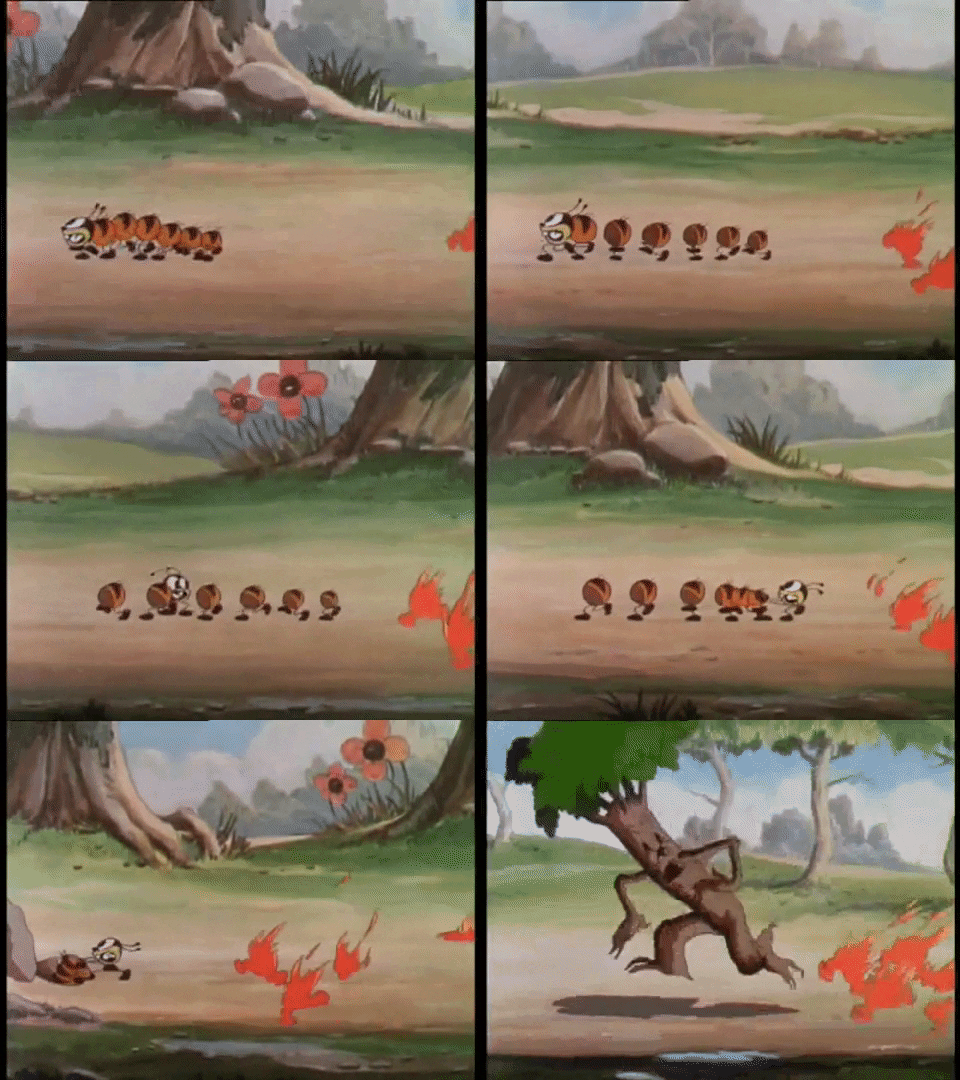
Directed by Burt Gillett, “Flowers and Trees” is set in a typical Disney type forest full of cute anthropomorphic animals and plants waking up to a new day. The plot focuses two young trees in love, whose courtship is interrupted by a jealous gnarled tree who makes a play for the girl and after being rejected, attempts to burn the entire forest to the ground. In the end the fire is put out by the woodland critters and the only thing burnt to a crisp is the villain himself, while the young couple end up getting married.
The cartoon is balanced between the main dramatic character animation of the three trees and the more gag based antics of the woodland critters which keep the story from getting too dry. The cartoon has no dialogue and the main strength of this short is the character animation which carries the entire burden of conveying the character and motivations of the main characters. With the male tree, there is just something about the way he is animated. He seems like nice eager young lad and there is just such a such pure enthusiasm for love and life in the way he is animated. The standout example is when to impress the girl he forms a makeshift harp from another tree and plays a tune. Not only is the animation of the finger work impressive, but the tree puts his entire back into it and every part of him moves to play the instrument.
The female tree is likewise very expressive and fluid in her movements. While the fellow plays his harp, she is dancing back and forth to the music and for an oversized hunk of wood the way she swings and sways is very feminine, animation succeeding at making you believe that a tree of all things is a young girl in love. In contrast to all this, the antagonist tree lacks the fluidity of the other two and the animation in his movement is more jerky and ugly. Which works as as the rigidity and ugliness of his animation seems to reveal how ugly and rigid the tree’s own soul is and by merely a glance at the way he walks, even a child can tell right away that he’s bad news.
The detailed character animation is balanced out by the various gag animations which go on at the beginning of the cartoon and in between dramatic scenes. While there are a few gags I found to be funny; the bit where the catepillar is trying to escape the fire and is going so fast that his segments fall behind and he has to slow down to let them catch up is a highlight, most are not that funny thought still pretty cute.
This is definitely the best cartoon of the bunch, but the thing is that when I watched is the for the first time it was as part of a batch with the other Silly Symphony winners of the 1930’s and I think this may be the weakest of the bunch. Or at the very least it doesn’t rise to the height of “The Old Mill” or “The Ugly Duckling”. Which is an unfair comparison, but when I watched this there was just something I found lacking.
But, in the end “Flowers and Trees” was still a massive leap forward not only in the field of animation, but arguably in the field of cinema in general as Walt Disney was really one of the great innovators in Hollywood’s adoption of colour. Which I think goes along way to justifying the creation of an award for best cartoon that year. The point of the Oscars is to recognize greatness in the cinematic arts and to recognize advancements in the science of film and by giving the award to “Flowers and Trees” in a way Hollywood is recognizing that like any other genre of movie Animation is a living art form which has the ability to grow and evolve.
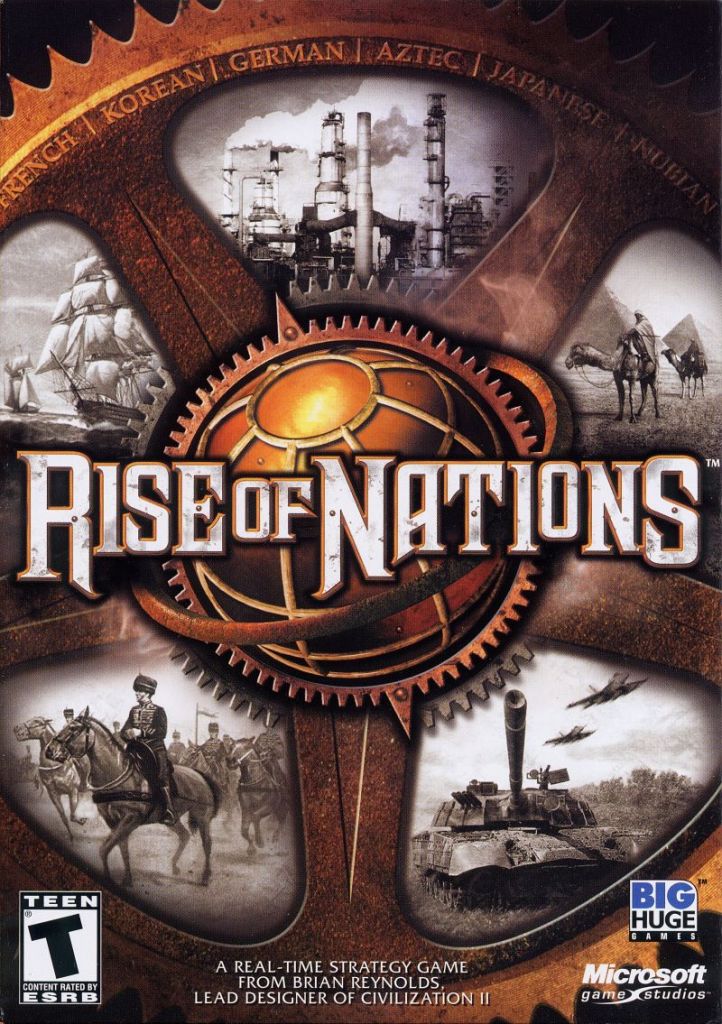
Hi, everyone. This is just a little piece I have written on a topic in video games which has always interested me, the type of gatefold PC box cover which were used in the late 90’s and early 2000’s. In particular I want to talk about one example in particular that I find memorable, the classic RTS Rise of Nations
I have had a weird history with strategy games, especially real time strategy games. When I first got into PC gaming at around 10 or so, they were the first genre I focused on, and for at least four or five years it was my bread and butter when it came to gaming. But as time went on I fell out of love with the genre and began to wonder if I had ever really liked strategy games or merely the idea of strategy games.
My love of strategy games had a simple enough origins, I have always liked history. I read pretty much anything on the subject I could get my hand on and one of my favorite joys in life was every Friday when Dad would drive me into town and take me to the library after school and I would just spend one or two hours camped out in the non fiction section. So by the time I got into PC gaming, I was already very interested in history as a subject.
So when one day I had to go with my Mother and Grandmother to Costco, I wandered off into the electronics section which back then actually carried computer games and I saw a game called Rise of Nations that caught my eye.
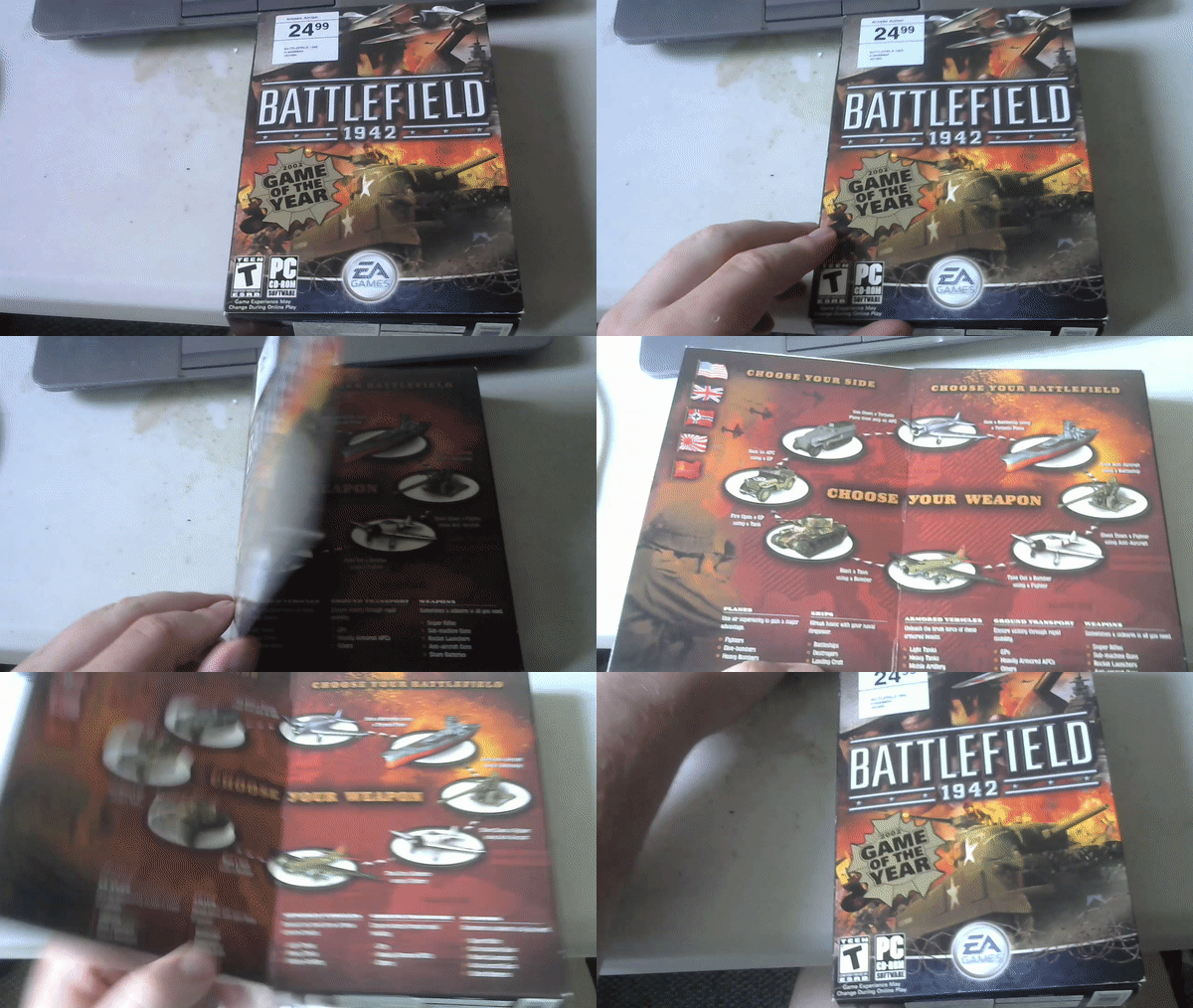
Rise of Nations came in one of those gatefold boxes that computer games used to come in, not the big unwieldy ones from the 90’s, but the slightly later smaller ones that were commons in the 2000’s. For those who do not know, the way gatefold covers work is that the regular cover of the box is only attached to the box on one side allowing it to be drawn back and second larger cover is revealed.
How a gatefold box cover works using my copy of BF 1942. The very first GIF I’ve ever made.
The issue with most game covers is that they are generally pretty rote, don’t actually tell you that much about the game and half of the title is taken up by things like the title, ESRB ratings and the developer and publisher logo. The extra space allowed to the gatefold cover and the fact that it doesn’t have to be as immediately eye catching as the actual cover, allows for more creative freedom and more opportunity to tell you why this game you want to be is going to be so awesome. This is definitely the case with Rise of Nations where the actual cover of the game is decent, but the gatefold is a thing of beauty.
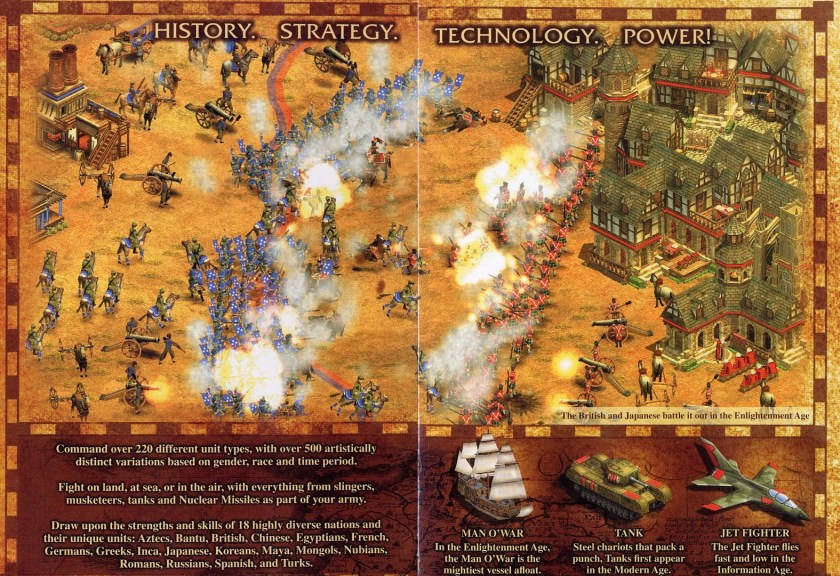
The gatefold cover shows a scene from the game with two groups of soldiers in the enlightenment era are going at each other, the Japanese in Blue on the left and the British in Red on the right. The center of the picture is dominated by two groups of infantry organized into orderly lines firing volleys at each other, white smoke filling the air. While behind the infantry on both sides, cannons are firing and cavalry is milling about. The picture is framed by the buildings belonging to both sides, the battle evidently taking place in a short gap between two cities. Above reads “History. Strategy. Technology. Power” summing up the themes of the game in four short words.
It really is hard for me to overstate how amazing I thought the game was. The graphics were cutting edge for the time, so many little soldiers rendered in detail and ordered up into tiny little ranks and the battlefield layered in smoke and muzzle flashes. It wasn’t just technically impressive either. I still think that the art design for the game is brilliant with the of the units and buildings having their own distinct look for each era of the game and even varying in some cases depending on the civilization. They are not only visually appealing, but you can tell what they are supposed to be and what faction they belong to, always important in an RTS game . I did not know at the time that video game graphics could even be that good and it looked exactly what I imagined when I was reading about all of these old battles.
What really blew my mind was the text that they had written below the screenshot which was packed with what was in the game. “220 different unit types”, “500 artistically distinct variations based on gender, race and time period.”, “slingers”, “musketeers,”tanks” and “Nuclear Missiles”. Then to cap it all off, they listed all 18 nations in the game, “Aztecs, Bantu, British, Chinese, Egyptians, French, Germans, Greeks, Inca, Japanese, Koreans, Maya, Mongols, Nubians, Romans Russians, Spanish, and Turks”. This is what made the game so fascinating to me, it seemed like I could take all of the civilizations I read about in my books and smash them against each other across time and space in a sandbox environment, just like it showed in that screenshot. My imagination ran wild with what I thought was possible, Aztec archers raining down fire arrows on British Red Coats on a medieval battlefield, D-Day only with Nubians landings on the beach against Maya defenders, Inca laying siege to Russian cities. Of course many of things I imagined were in the game were not actually included, but I didn’t know that looking at the box. To me it seemed like Rise of Nations was a game where anything was possible.
I think this illustrates what I love so much about gatefold covers. The extra space that the publisher gets to play with, space that doesn’t have to include a large logo or focus on being immediately eye catching, gives them opportunity to sell and promote their games in more in depth and original ways that can better entrance the imagination of the potential buyer. I have such fond memories of wondering around electronics stores like in the early 2000’s and just going through the various games in the PC section and poring over every single boxed game they had trying to absorb any shred of info like a sponge.
I think what this did was that it helped open up my mind to new experiences that video games could offer that I wouldn’t have normally encountered otherwise. It showed me that no matter how many great games I would play that there would always be more, that the gaming hobby as a whole was a wide universe which had a level of depth that I could never hope to entirely fathom on my own. This is what the effects of gatefold covers had on my and why I still enjoy looking at and collecting them.
I hope all of you enjoyed my little article and if any of you have any gatefold covers that you thought were particularly neat, please share them in the comments section.
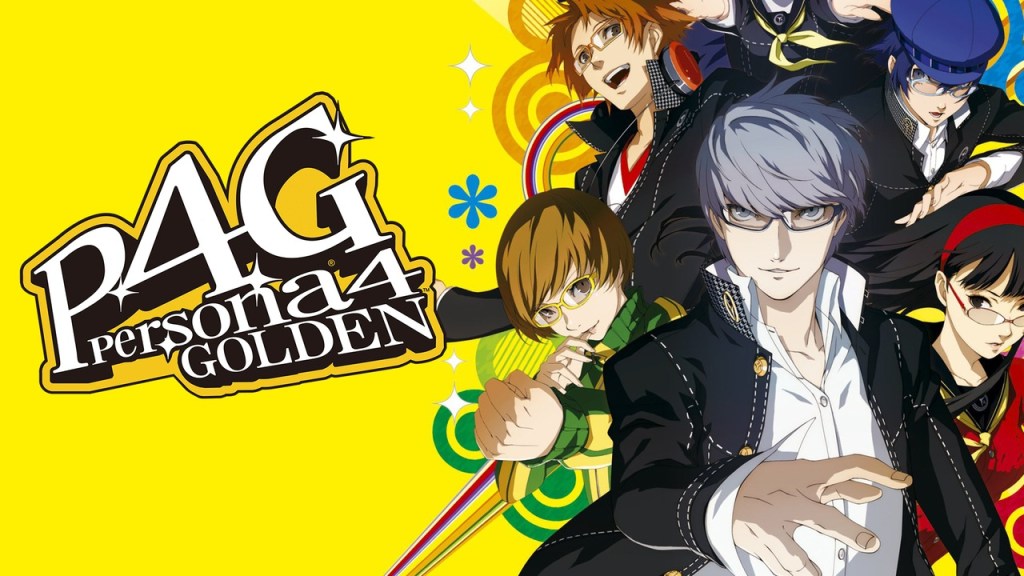
Hello, I finished Persona 4 recently after 75 hours or so of gameplay and loved it. I’ve been trying to write more and wanted to write something about the game, but seeing as how Persona 4 is already a pretty well beloved game and you really don’t need me to recommend it to you, I decided to do something a bit different from a review and instead mostly talk about why I liked this game so much.
There is a term that gets tossed around a bit when talking about video games called “ludonarrative dissonance”. The idea is that in games there is often a conflict between the narrative and themes of the story versus the what the player is actually doing in the gameplay. In particular the idea is that the actual gameplay of the game undermines its own narrative. For instance in Grand Theft Auto IV, the narrative would have you believe that Niko Bellic doesn’t really want to get involved in a life of crime, but is gradually dragged into a mire of crime and violence by events and poor decisions. This is undermined by the fact that the actual gameplay loop is the same as every other GTA game and you act like a total maniac from the beginning. I have developed a pretty high tolerance for luddonarrative dissonance over the years out of necessity, but when I see a game where the gameplay and narrative are in sync I admire that, and very few games I have ever played do this as well as Persona 4
The plot of Persona 4 begins when you, the archetypical silent protagonist move into the small Japanese town of Inaba to live with your uncle and cousin for a year. In Inaba there is an urban legend about the “Midnight Channel”, a special TV channel which can only be seen at midnight on a rainy evening. Soon after you arrive two grizzly murders occur and both the victims were seen on this mysterious channel prior to their deaths. You and your friends discover that the “Midnight Channel” is a window into a parallel world full of shadows which can be reached by going through the TV screen. and that the murderer is killing his victims by tossing them through the TV and letting the shadows kill them. The heroes must journey into the TV world to rescue any potential victims from these shadows and discover who is doing all of this.
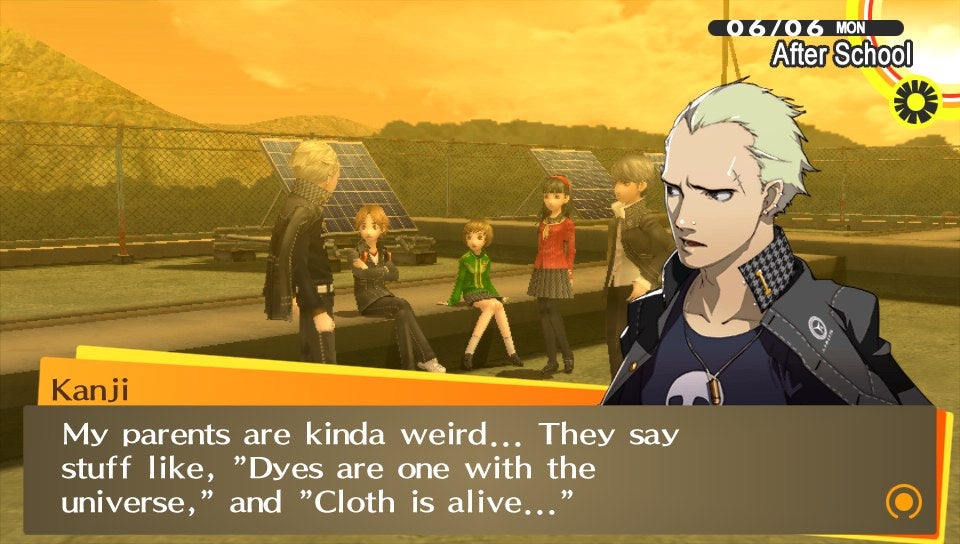
The gameplay of Persona 4 is divided into two halves. Most of the time you are just a regular high school student going through his day to day life in the manner of an RPG or more particularly one of those dating sims that are so popular in Japan. You go to class and then after school each day you have some free time to hang out with friends, do part time jobs or participate in after school activity, with most of these tying into the main gameplay mechanic of this part of the game the “Social Link” system. The idea with this is that all of these other characters you interact with have their own personal issues and as you become their friend you help them deal with their problems and grow as a person. For instance one of your party members is Kanji, who is your standard macho delinquent with a heart of gold, but he has a bunch of stereotypical feminine interests like sewing, which he keeps hidden for fear of seeming unmanly. As you build your relationship with him you can help him overcome this internal conflict, reconcile the two sides of his personality and accept who he is.
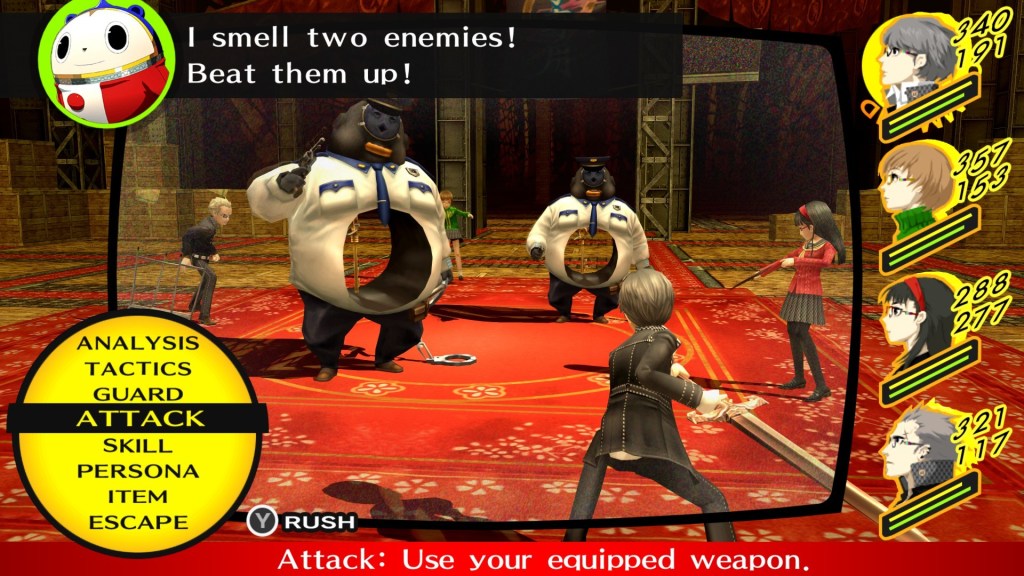
The other half of the game is when you journey through the TV and go through a series of semi randomized dungeons full of shadows. The way you fight these shadows is through something called “Personas”. A “Persona” is manifestations of your own personality in the form of a mythical creature or being which you can summon to fight and defend against the shadows. While most characters in the game have only the one “Persona” they can use, the protagonist is a bit of a blank slate and has the ability to manifest multiple “Personas”. The easiest way to understand “Personas” is that they are basically Pokemon, they are creatures with a variety of moves some of which are buffs or static attributes but are usually physical or elemental attacks and both the “Personas” and the different types of shadows all have their various elemental strengths and weaknesses and much of the strategy is knowing which “Persona” and move to use against what personality. Will these “Personas” can level up a bit on their own and you can acquire new “Personas” through combat, the real way to build up your own strength is by fusing different weaker “Personas” into newer stronger ones. The way this ties into the social of the game is that each of the social links you develop is tied to a specific type of monster and the stronger that social relationship is, the stronger that monster will be
The logic of the game is that “Personas” are manifestations of your own personality, so by developing social relationships you can grow as a person and this emotional and psychic growth causes the “Personas” you create to become stronger. This is what I mean by saying that Persona 4 lacks ludonarrative dissonance and has harmony between gameplay and narrative. The basic theme of Persona is that by forming bonds with others you can achieve personal growth and overcome obstacles created by negativity. Each aspect of the core gameplay loop corresponds with an aspect of the theme. The shadows are literally personified negative emotions, fighting them is overcoming negativity and other obstacles, building up social links is forming bonds with other people and the ability to level up and create new and stronger “Personas” is the ability to grow as a person. Therefore when the plot and the various side narratives advance it causes a corresponding growth of the players strength in the gameplay, which in turn allows you to beat your enemies and advance the plot, which creates a virtuous cycle where advances in one aspect of the game lead to advances in the other, creating a perfect harmony between gameplay and narrative.
It is this aspect which I think makes Persona 4 such a great JRPG, as not only does it have well written plot and characters and a deep and complex gameplay system which alone would have made it a very good JRPG, it also has this beautiful integration of narrative and gameplay into one harmonious whole which has rarely been matched in video games.
I was a big fan of FPS games growing up, the original Call of Duty, Medal of Honour, Brothers in Arms, Half Life 2 were my bread and butter when it came to gaming. As time went by though, my interest in the genre began to wane especially in these last few years. Prior playing Doom this month, the last time I played a shooter was Gears of War 3 two years ago, which isn’t even an FPS! Because of this, I have missed the big revival of single player first person shooters in recent years such as Wolfenstein : New Order and Doom (2016). But, I keep on hearing how great these games are and figure I should give them a try.
Despite all I said about being a big shooter fan when I was younger, I’ve never actually played any of the Doom games. I was born in 1993, so the first two were before my time and Doom 3 never really appealed to me that much with its horror focus. This being the case I had originally planned to play Wolfenstein: New Order on the PC first, but after my computer broke down, I went with Doom on the PS4 instead. I am absolutely glad I did chose Doom though, as it has some of the most fast paced, challenging, brutal and just plain fun gameplay I have played in recent years.
Doom is set in the future on a martian research station which has opened a series of conduits to Hell in order to harvest infernal power as a clean energy source. This does not end well and a rogue researcher opens a full portal to Hell and a demonic horde comes rushing through. In desperation you, the Doom marine have been awakened from status to fight back and seal the dimensional gate.
The setting and plot are not what you play Doom for, but they work well for what they are. The plot is pretty basic, but the whole using satanic energy as a renewable energy source is a novel twist on the old doom formula. More importantly the game nails the atmosphere of the setting with the horroresque vistas of once sterile research facilities now caked with blood and gore, windswept martian exteriors and grotesque demonic hellscapes. I say horroresque because it is not really a horror game , but it definitely has that aesthetic and ends up feeling like something you would see on a Iron Maiden cover.
The atmosphere is supported by the game’s excellent graphics, which well maybe not the most technically proficient (I had a recurring issue with textures loading too slowly) are nonetheless very well designed, with each level looking fairly unique and loaded with interesting little details in various nooks and crannies to explore.In particular the use of colour especially in the outdoor martian areas and in the Hell levels is striking, full with bright reds and yellows. It is nice to have a game which gets away from the muted browns of many other modern shooters. What most impressed me though, is how well the enemies are designed with each being visually distinct and horrific in their own little unique way making them easy to identify in the midst of a hectic gun fight.
Which brings us to the core of what makes Doom work, the gameplay. Doom is a throwback to an earlier age of first person shooters, with fast paced gameplay divided into a series of discrete levels each with their own little bonus goals and secrets. What makes this game work is how fast it is, unlike a lot of more lumbering modern shooters. The Doom Marine is nimble and light on his feet, able to dive into a mob of demons and dart back out with ease. This gets even better when you gain access to the double jump about a third of the way through the game and can add a vertical dimension to your manaverouring. Furthermore, Doom has something has called glory kills where an enemy is stunned if you do enough damage and get a chance to to perform a gruesome fatality in order to regain a chunk of your health back. This is the game’s most brilliant mechanic as it encourages you to be very aggressive at all times, even when low on health your best option is not to retreat and hide but to go on the offensive and gain health back through glory kills.
And you are going to need all that extra health because the enemies are formidable. The game has a wide variety of enemies with vastly different visual and gameplay designs. Small scurrying imps which climb on the wall to throw fireballs, weird bipedal pinkies which charge at you and have to attacked from behind, floating skulls which suicide rush you and giant Hell Knights who will just stomp you into the ground. Even the little guys can be dangerous. For instance, with me personally I always prioritized going after the imps last because they are generally the least dangerous, but I still died more than once to them because I was so focused on killing bigger things that I would end up being nailed in the back with a fire ball. Needless to say the gameplay is pretty challenging! Thankfully, you have a lot of tools at your disposal which can even the score.
By the end of the game you have access to 8 different main weapons, a fairly useless basic pistol (though I suspect that it can be pretty effective if you know how to use it), a basic shotgun, a double shotgun, an assault rifle,a chain gun, a plasma rifle, a railgun and a rocket launcher. Each of these are fairly unique with their own strengths and weaknesses and while you are definitely going to have a few favorites, all will need to be utilized in order to be fully effective.
These weapons can be further customized by an upgrade system you get for performing well in combat, finding weapons drones and beating level objectives. Essentially most guns have two alternate fire modes which can be further upgraded and these alternate fire modes can drastically increase the guns effectiveness and change how you use them. My favorite is the siege mode for the rail gun which basically plants you in a stationary position and gives the gun a longer charge up time, but when it does fire it will shoot a powerful beam of energy and kill pretty much everything in a straight line. In addition to these basic weapons, you have access to the chainsaw which will kill anythingl in one blow with enough fuel and provide you with a large pile of ammo for your troubles and the BFG which will eviscerate everything in the immediate vicinity. These weapon upgrades combined with stats upgrades and various runes mean that you can go toe to toe with pretty much everything in the game. Essentially, the demons are scary, but you’re scarier still!
All of this takes place in some of the best level design I have seen in a first person shooter. The gameplay is split between these vast areas where you explore and fight the occasional bad guy, and smaller confined arena like areas where enemy attacks come from every side you have to maneuver around like hell in order to survive. So the game develops a good rhythm between less tense exploring sections and intense arena sections where you have to fight for your life. Rhythm is the core of the gameplay, you are constantly having to switch up what you are doing or what gun you are using in order to survive, but these switch ups have a pattern and once you get into that pattern you can begin to master and control these combat situations.
Like I have been saying over and over this is an amazing game and I can say nothing more aside from BUY THIS GAME NOW!
Before we got started this review is only for the base game and the DLC will be covered at a future date.
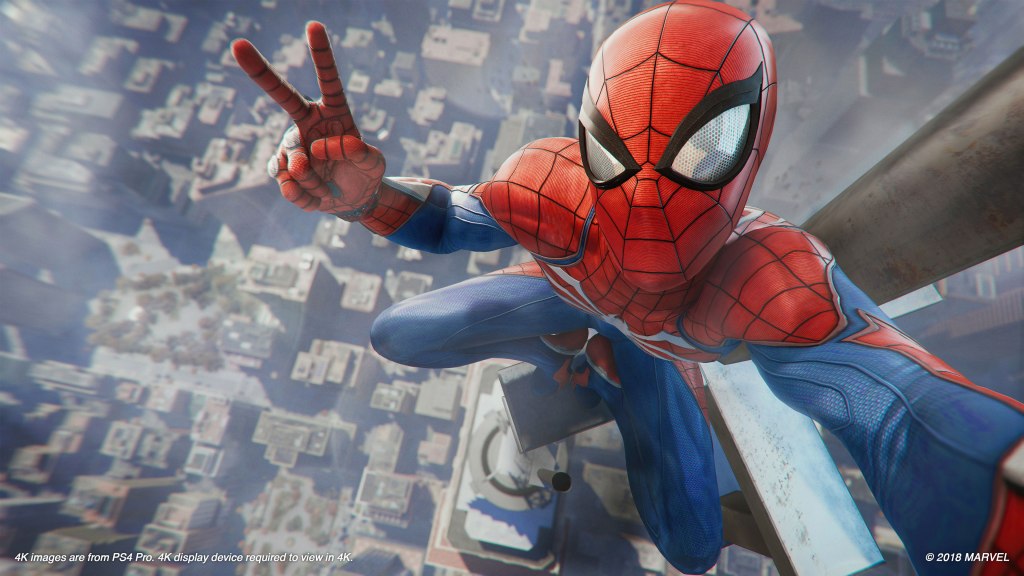
I have always been a big Spider-Man fan. Ever since I got my first tape of the 90’s cartoon from the local rental place I was hooked. This love only increased when I saw the Sam Rami Spider-Man films in the early 2000’s, I was just the right age for it and it cemented my idea of what a superhero was. So when I heard that they were making a new Spider-Man game in the style of the Batman Arkham games (It wasn’t until I actually started playing that I realized that Rocksteady hadn’t made this) I was so excited. Now having finally played I can safely say that this game is exactly what I wanted it to be.
The game starts when Spider-Man in coordination with the police finally takes down Wilson Fisk, The Kingpin of Crime. In the aftermath of Kingpin’s fall a vacuum arises in the New York underworld which is gradually being filled by a brand new villain Mr. Negative who is taking out the remnants of Kingpin’s empire. While Spider-Man stop the mysterious menace of Mr. Negative? And what is the origin behind his grisly grudge against Norman Osbourne? Find out True Believers by playing Marvel’s Spider-Man!!!
Basically the structure of the game is that you get to play around in an open-world version of Manhattan doing Spider-Man things while gradually playing a series of story quests which move the plot forward. What this game gets right is the way you move and fight. Arkham was always described as the game where you get to feel like Batman, while this game where you get to feel like Spider-Man. You have a variety of movements from your standard web-swinging to more advanced stuff like ziplining and hanging from ceilings. Web-slinging is for the most part very intuitive and fluid, giving you the ability to transverse large areas both horizontally and vertically in a very quick and fun manner. However some of the more advanced moves are kind of tricky to utilize properly, wall crawling in particular is far too finicky.
Combat is also great, if not quite as intuitive as movement. You have the one combat button which makes beating up your standard mooks pretty simple, but the more advanced moves are a bit trickier. You can do a LOT during combat, web baddies up, throw stuff at gangs, yank rockets out of the air and hurl them right back at perps. Your moves are supplemented by the use of gadgets such as impact webbing, Spider-Drones and zip-webs. To paraphrase a different superhero film, “where does he get all those wonderful toys?” Essentially the combat system is very deep, much more so than the Arkham games and you have a lot of different ways to deal with enemies, but I do find the combat to be kind of overwhelming with its options and some of the moves are again kind of finicky.
Most of the time not spent on story missions will be focused on side quests and there a lot of them. You can do things from finding hidden items, taking photographs of New York landmarks, take on challenges from the Task Master, find an old man’s lost pigeons (a lot more fun than it sounds) and stop random crimes that come up on the police scanner. All of these missions are fun and what I think makes them so is that there is never a moment where you don’t feel like you’re Spider-Man. The biggest example of this for me is when you get called by Aunt May to go to supper or something, but get delayed when you see some crime being committed and you have to stop it, which is like the most Spider-Man thing ever. There are a bit too many missions which just seem to involve beating up random thugs for my taste, but the rest are varied and have you exercising a wide variety of skills. The only missions I really don’t like are the stealth ones, the stealth mechanics in this game just aren’t that good and most of the time I recall the games controls being kind of finicky tend to involve moments where I’m trying to be all sneaky like and accidentally land right in front of some goons because I didn’t do it just right.
As I have mentioned to the point of monotony the game’s developers are really good at making you feel like Spider-Man and that is particularly true with the way they handle the plot and the lore. This does not follow the continuity in the comics, but the game does a great job of making it feel like Spider-Man has been at this a while and has some history to him. At this point in his career he has graduated from high school and undergrad, moved out on his own, fought most of his major bad guys and revealed his identity to Mary-Jane. The game does a great job of portraying Spider-Man’s supporting cast through acting and writing, the obvious standout being crusading reporter and podcast host J. Jonah Jameson who will stop at nothing to make NYC aware of the menace that is Spider-Man!
Speaking of New York, the game looks gorgeous and the environments are lovingly designed from Wall Street skyscrapers to Harlem projects all with real world and comic book locations thrown in with great detail. It reminds so much of the Rami films, which I still think are the best Spider-Man media ever produced, and I am so happy with the level of care and detail the designers put in. For instance, the game has a whole bunch of secret outfits to unlock, including the outfit from the Raimi films and you better believe I spent the entire game wearing that one!
Another thing is the fact that creators are clearly very familiar with the comics and are willing to do some interesting things with the source material. The most obvious example of this is using Mr. Negative as the main antagonist for most of the game which is pretty daring considering he is a fairly recent character in the comics ( I know he was introduced after OMD at least). I also love the way they retold Doc-Ock’s relationship with Spider-Man into more of a mentor-student one, making his inevitable downfall very poignant.
I do have one quibble in that I think they focus too much on Spider-Man as a street level hero and don’t have nearly enough super-villains. It gets better by the final act, but for the majority of the game the only proper villains you fight in the main story are Kingpin, Shocker and Mr. Negative, as well as Tombstone and Taskmaster (who’s not even a Spider-Man villain) if you do some of the side missions.
Overall this is a great game and I am currently leaning towards naming it the greatest superhero game ever over Arkham City
4.5/5
Stay tuned true believers for a future raucous rant full of razzle-dazzle for dramatic DLC dynamite featuring everyone’s favorite spiffy, spunky superhero, Spidey!
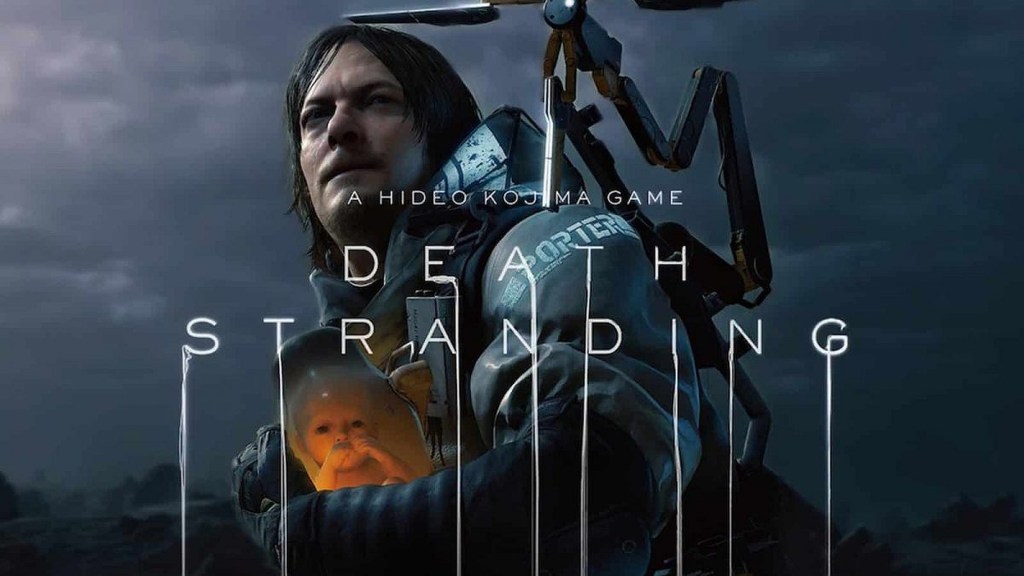
When Hideo Kojima released Metal Gear Solid 2 in 2001, the game soon became a byword for nonsensical, self indulgent plot. While no one would deny that MGS 2 is self indulgent, it has become apparent of the succeeding two decades that themes and questions Kojima has raised are extremely relevant and poignant and that the game was ahead of its time. Similarly when Deathstranding was released in the fall of 2019, it was likewise ridiculed for being self indulgent and nonsensical, but unlike MGS 2 the game relevance of the game has become exceedingly apparent in far less than two decades..
Death Stranding is set in a post-apocalyptic world where society has pretty much collapsed into a series of isolated communities and households after an event called the “Death Stranding” which caused the collapse of communication networks across the world and the fall of the United States. What was once America is now a series of isolated settlements and households divided by vast swathes of blasted landscape haunted by “B.T.s” which are pretty much ghosts created by the Death Stranding. Ironically for a post-apocalyptic world technology has managed to advance far enough that people’s material needs are still able to be met through stuff such as 3D printing and the like. But, there is still the need for some communication and transport between various households and communities and that is where Sam Porter Bridges the protagonist comes in.
Sam is a courier, couriers in this setting are pretty much the only people willing to brave the outside world and deliver information and goods from place to place. Sam is the best at what he does and so gets recruited by the UCA which is a coalition of settlements intent on reforging the United States. Sam’s task is basically to go around to the various settlements and households and reconnect them to the “Network” which is basically the game’s equivalent of the internet and so allow the various isolated parts of America to be in communication with each other and so form a nation once again. As the story goes on things become more complicated and questions arise about why the Death Stranding happened, what the UCA’s real motivations are and what are the motivations of its opponents.
2020 has been a terrible year, probably the single worst year in the post-war era. We have a mass pandemic with the ensuing fall out from that and while the end does finally seem to be in sight, we still have a lot more to go through before we get there. Death is everywhere around us, unnecessary in person social interaction has become taboo by necessity and every one has become increasingly isolated and withdrawn.This game feels so much like 2020, more than any game actually released in this year, with it’s themes of isolation and death.
The actual gameplay of Death Stranding is fairly simple in concept, you are a courier, you travel from point A to point B delivering goods and then you repeat. While you do have vehicles for the latter part of the game, Death Stranding really is mostly a walking simulator. The thing is the walking in Death Stranding feels really good. The main challenge comes from the fact that as a porter you are trying to balance a big stack of boxes and containers on your back and so have to make sure to keep your balance at all times. This is made trickier by the elaborate terrain design of the game with its numerous cliffs, valleys, streams and forests. You have access to a built in terrain scanner which you have to use to figure out what terrain is easily passable, what is impassible and what is risky but doable. Do you want to take a risk and go through a tricky area if it means the route will be shorter? Is the river safe to cross if you just avoid the deep currents? How do I get down from this cliff? Can I get through this area by vehicle or should I play it safe and do it by foot?
You are aided in your journey by the variety of tools and equipment you can use, for instance you can put down a ladder to make a stream passable and a rope to rappel down the mountains. The game is very good at pacing out how often you get these new tools and organically creating situations which showcase their abilities and limits. For instance when you first get access to a vehicle you are initially tasked with doing some backtracking over areas you have already covered, which shows you how to use the vehicle on terrain you are already comfortable with and how a good path for vehicles differs from a good foot path. However after you do this, you are sent to a new location which requires passing through a narrow ravine full of ghosts. You will naturally want to use your new vehicle for this and you will discover that some terrain should never be traversed by vehicles and why you are still going to want to be walking around on foot most of the time.
All of this walking though challenging becomes very relaxing and this combined with the beauty of the terrain and the sheer isolation you are in creates a sense of peace and an almost spiritual mood where it’s just you and nature. And when you do finally carve a new path through tricky areas like snowy mountains it feels utterly satisfying.
However you are not entirely alone in this game. The gameplay is almost pseudo-online, in that you are not the only courier in the game map, and while I am not sure of the technical details of how it’s done, when you play the game if you leave an object or a structure on the map it is uploaded to the server where other players can use it when they play. So even though you are alone you can still find helpful bridges and paths created by other players. After a while all this adds up to a feeling that the map is becoming less desolate and more built up, especially in the later stages where you and several players can start to build actual paved roads!
This creates a final interacting aspect to the game where your score for want of a better term is based on the amount of likes you get, if you deliver your goods quickly and without damage you will receive a better score and level up. But you can also send likes to other players as a thank you for using your equipment and likewise receive likes for doing the same. This creates an incentive structure where people want to help each other and is a sort of a commentary on the positive aspects of the internet and suggests that even in these times of great isolation we can still find news ways to form connections with each other.
In conclusion Death stranding is the game of the year for 2020 in my view, even though it came out at the end of 2019 it says more about the experience we are in this year than any other game that came out this year. Will this game may not entirely be to everyone’s taste, it is very slowly paced and even after 40 hours I didn’t reach the ending, I would still strongly recommend the game to anyone and everyone to at least try. Personally I believe this is the best game of 2020 and the best game Kojima has ever made.

 Mr.Kltpzyxm's Games and Comics Blog